
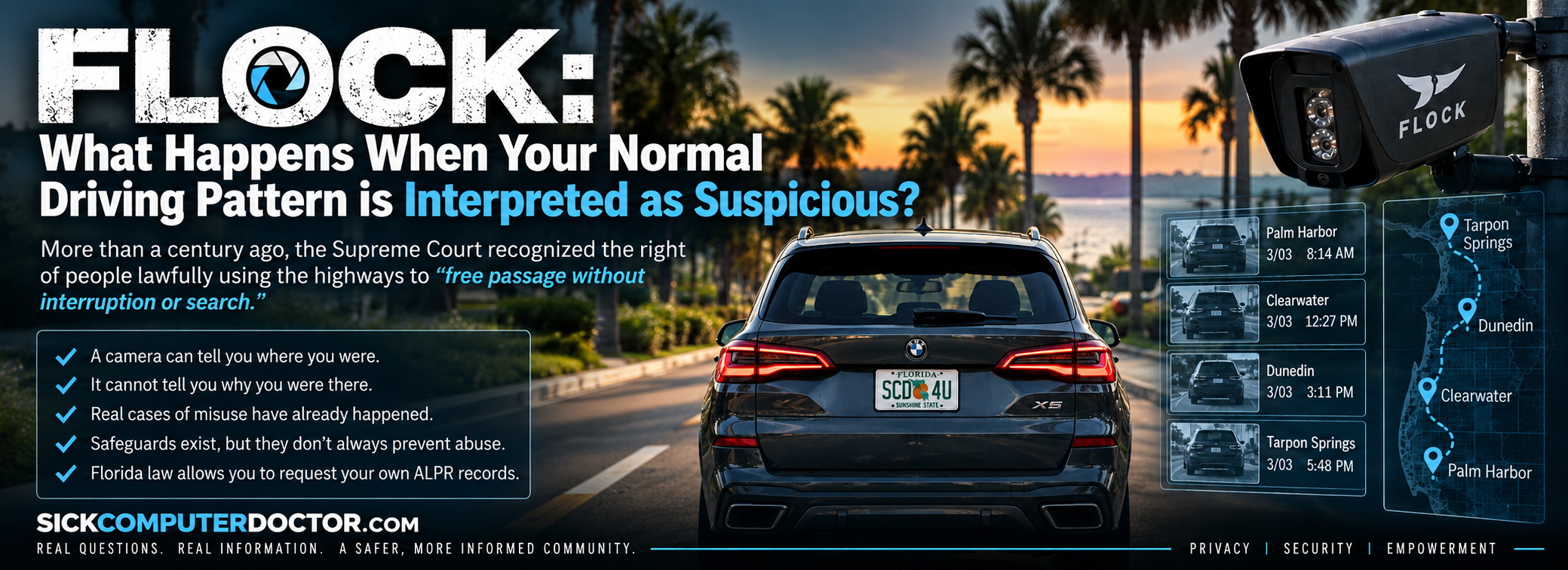
More than a century ago, the Supreme Court recognized the right of people lawfully using the highways to “free passage without interruption or search.”
That statement came with a qualification: the Court upheld a warrantless automobile search supported by probable cause to believe the vehicle carried contraband. It was not announcing an unlimited right against automobile searches. Carroll v. United States, 267 U.S. 132, 153–154 (1925).
Those words came from a time before automated networks could record and retrieve vehicle sightings at today’s scale.
There were no Flock cameras automatically reading license plates. There were no networks of automated license plate readers recording where vehicles appeared. There were no databases capable of quickly searching accumulated observations and using them to reconstruct patterns of travel.
Today, simply driving public roads can create a digital history of where your vehicle has been. Flock itself says automatic license-plate readers can read up to 900 license plates per minute. That’s about 15 plates per second. That’s almost the population of At the advertised maximum, one camera could theoretically process up to 54,000 plate reads per hour. In just over an hour, ALPR could process the plates of the entire population of Palm Harbor or Largo. An ordinary drive to the store or beach can become part of a very large searchable dataset.
And that raises a question the Supreme Court could not have contemplated a century ago:
What happens when exercising that free passage creates a pattern that someone in government interprets as suspicious?
For me, that isn’t difficult to imagine.
I own a mobile computer repair business.
On any given day, my vehicle might be in Palm Harbor in the morning, Clearwater around lunch time, Dunedin that afternoon, Tarpon Springs and back to Palm Harbor before I finally head home.
I drive to people’s homes and businesses. I pick up computers. I return repaired equipment. I may visit the same neighborhood several times in a month or a day because I have different customers who live there.
There is nothing suspicious about that pattern.
I’m working.
But a Flock camera doesn’t know that.
My License Plate Doesn’t Have a Profession
An automated license plate reader doesn’t know I’m a computer technician.
It doesn’t know that I spent two hours parked in front of someone’s house because their computer wouldn’t boot. It doesn’t know the laptop in my vehicle belongs to a customer. It doesn’t know why I returned to the same neighborhood three times.
It records something much simpler:
My vehicle was here. At this time. On this date.
Collect enough of those observations over time, however, and they can become something much more revealing:
A searchable history of where my vehicle has been.
That’s where something completely innocent can potentially begin to look like something else.
Flock ALPR Data Has No Context
I’ve been stopped by police and told I was stopped because ALPR couldn’t read my plate!
Imagine police are investigating suspected drug activity in a particular area.
I happen to have several customers there.
A search of available historical license plate reader data shows my vehicle has appeared in that area repeatedly.
How far back a search can go depends on the applicable retention period and whether records have been lawfully preserved elsewhere. Flock’s public materials currently describe different retention periods; Pinellas County is now reportedly 30 days. Prior to all the media hoopla, that retention period was 2 years. I have not independently verified the current retention policies for each local agency. See Flock’s evidence policy and data privacy page.
Someone notices.
Why does this vehicle keep showing up here?
So they look further.
Now they see sightings near residential neighborhoods throughout the county.
In reality, I arrive at a customer’s home, stay for an hour or two, leave and visit another customer. But a roadside ALPR sighting does not, by itself, establish which home I visited or how long I stayed. It records a vehicle at a camera location and time. Connecting those sightings to particular addresses or visits would require additional information or inference.
Maybe I return to some of those addresses later.
From my perspective, the explanation is simple:
Those are my customers.
But remove the words computer repair, service call and customer.
What’s left?
A vehicle repeatedly observed around the county and in an area already being investigated—with someone potentially filling in the gaps about where it went and what it was doing.
The underlying data hasn’t changed.
Someone’s interpretation of the data has.
And that distinction matters.
What Happens When the Pattern Becomes the Suspicion?
Suppose an investigator decides my movements deserve a closer look.
Maybe my license plate gets searched again.
Maybe someone looks backward through whatever previous sightings are still available.
Maybe my vehicle is placed on an alert or hot list so an officer receives a notification the next time an ALPR camera sees it.
Now imagine I drive back into that neighborhood for another completely legitimate service call.
The camera reads my plate.
An alert is generated.
An officer sees my vehicle.
Maybe I’m followed.
Maybe eventually I’m stopped.
An alert is an investigative lead; it does not automatically establish a lawful basis for a stop. Whether a stop is justified depends on the facts and the applicable legal standard.
Something significant has happened at that point.
I haven’t become suspicious because an officer witnessed me committing a crime.
My pattern of otherwise lawful movement has been interpreted as suspicious.
And there’s a fundamental limitation in ALPR data that shouldn’t get lost simply because we’ve accumulated more of it:
A license plate reader can tell you where a vehicle was observed. It cannot tell you why it was there.
A sighting doesn’t necessarily tell you who was driving.
The registered owner isn’t necessarily the person behind the wheel.
A location doesn’t explain someone’s purpose for being there.
A timestamp doesn’t establish criminal activity.
And collecting thousands of observations doesn’t magically supply the context missing from each one.
Data doesn’t explain itself. People interpret it.
When Observation Leads to Police Interference
This is where that opening Supreme Court statement becomes important.
The language comes from the Supreme Court’s 1925 decision in Carroll v. United States. The Court was considering automobile searches and recognized both the government’s authority to search a vehicle when probable cause exists and the right of lawful highway travelers to free passage without unjustified interruption or search.
More than fifty years later, the Court addressed discretionary vehicle stops in Delaware v. Prouse, 440 U.S. 648 (1979).
The Court rejected a discretionary license-and-registration stop unsupported by articulable, reasonable suspicion that the driver was unlicensed, the vehicle unregistered, or the vehicle or an occupant otherwise subject to seizure for a legal violation. It distinguished methods that constrain officer discretion, such as stopping all oncoming traffic at a roadblock. It also warned against people in automobiles having their travel and privacy interfered with at the unbridled discretion of police officers.
Neither case involved Flock.
Neither case decided whether maintaining or searching an ALPR database is itself unconstitutional.
And I’m certainly not suggesting police aren’t allowed to see a license plate that’s plainly visible on a public road.
The harder question comes later.
What happens when the government’s justification for interfering with your travel begins with the fact that you’ve been traveling?
If my vehicle repeatedly appearing in different neighborhoods becomes the reason to investigate me, follow me or eventually stop me, we’re no longer talking only about a camera observing a publicly visible license plate.
We’re talking about government action resulting from an interpretation of accumulated travel history.
Investigating, observing and stopping someone are different actions with different legal requirements. Innocent conduct can contribute to reasonable suspicion when considered with other specific facts; it need not be a witnessed crime. My concern is what happens when context is missing and assumptions do the work.
That’s the constitutional conversation I think we should be having.
We Already Know These Systems Can Be Abused
One answer to privacy concerns about systems such as Flock is that safeguards exist.
Users have accounts. Searches can be logged. Agencies can establish policies. Access can be audited.
Those are important cybersecurity controls.
But documented cases demonstrate an uncomfortable reality:
Having safeguards isn’t the same thing as preventing abuse.
In Albany County, New York, authorities accused investigator Laurie Moore of conducting more than 4,000 unauthorized Flock searches, about 3,000 involving an ex-girlfriend’s vehicle and others involving four acquaintances. She was charged in September 2026 with misdemeanor official misconduct and falsifying business records. These are allegations, not a conviction. WAMC reporting, published by WXXI.
In Pennsylvania, former Frazer Township officer Michael McSherry pleaded guilty in December 2021 to stalking his estranged wife. Local reporting described his use of the department’s license plate reader to track her car and her mother’s. This is an ALPR misuse example, not a claim that the system was Flock. WPXI’s court reporting.
These aren’t merely imagined capabilities.
The Pennsylvania case resulted in a guilty plea. In Albany County, authorities reported finding thousands of allegedly unauthorized searches.
And the Albany County case contains an especially important cybersecurity lesson: after the alleged misuse was discovered, the sheriff announced monthly audits, supervisor approval for searches and required case numbers.
In other words, protections were strengthened after thousands of allegedly unauthorized searches had already occurred.
From a cybersecurity perspective, that’s why saying “we have safeguards” isn’t enough.
An Audit Log Doesn’t Necessarily Stop Someone From Looking
Logging is an essential cybersecurity control.
But an audit log primarily creates accountability.
It can record that someone accessed information. It can record when they accessed it. It may record what they searched for and what justification they supplied.
That information can help uncover misuse.
But recording an improper search doesn’t necessarily prevent the improper search from happening.
By the time somebody reviews the audit trail, the information has already been accessed.
The same distinction matters in computer repair: being able to access something isn’t the same thing as needing to access it.
So asking whether searches are logged isn’t enough.
We should also ask who reviews those logs, how often they’re reviewed, what causes a search to be flagged, what justification must be entered and what happens when somebody repeatedly searches the same vehicle. Or, is the potential for abuse so great that it outweighs the crime fighting benefits?
But there’s another question that’s even more important if your vehicle is the one being searched.
How would you ever know?
If Someone Was Searching My Movements, Could I Find Out?
Suppose my hypothetical wasn’t hypothetical.
Suppose somebody actually noticed my vehicle appearing frequently throughout Pinellas County.
Suppose an investigator thought my completely ordinary business travel looked suspicious.
Suppose my plate was searched.
And searched again.
Maybe somebody looked backward through my previous sightings.
Maybe my plate was entered into an alert system.
Someone asked, would I ever know any of that happened?
Could I find out who searched my plate?
How many times?
When?
Why?
Could I discover whether somebody placed an alert on my vehicle?
Could I determine whether my information was shared with another agency?
Those questions led me directly to Florida’s public-records law.
Florida ALPR Records: What Does the Government Have About YOUR License Plate?
Florida Statute §316.0777 specifically addresses automated license plate recognition information.
Florida generally makes ALPR images and data containing or providing personally identifying information confidential and exempt from ordinary public-records disclosure.
That’s an important privacy protection.
I shouldn’t be able to submit a public-records request for your ALPR history simply because I’m curious about where you’ve been.
But Florida law contains an important exception.
The statute provides that ALPR information relating to a license plate registered to an individual may be disclosed to that individual, unless it constitutes active criminal intelligence or active criminal investigative information.
The statute says may, not must. It permits this disclosure; it does not promise access to every record I request. “Active” has a specific statutory meaning, including qualifying ongoing investigations and information directly related to pending prosecutions or appeals. Florida Statute §119.011(3).
That raises a very different question.
What Flock or ALPR information does the government have about MY license plate?
I want to know.
But I don’t want to stop with photographs and sightings.
I Want to Know Who Has Been Looking
If audit trails are one of the safeguards we’re supposed to rely upon, I want to find out what those records can tell the person whose movements were searched.
I want to know what ALPR records exist for my vehicle, where and when my plate was recorded, whether anyone has searched it, how many times it was searched, which agency or user performed those searches, what justification was entered, whether a search was associated with an incident or case, whether my plate has ever been placed on an alert or hot list, and whether information concerning my vehicle was shared with another agency.
I don’t yet know how many of those questions Florida’s public-records law will allow me to answer.
And that’s exactly why I’m going to ask.
Florida law expressly provides a mechanism through which certain ALPR information relating to an individual’s own registered plate may be disclosed to that individual.
That doesn’t necessarily mean every audit log, officer identity, investigative record or justification must be released. Other exemptions may apply, including protections for active investigations, surveillance techniques and certain personnel information. Florida Statute §119.071.
Rather than speculate, I’m going to test it.
I’m Preparing the Public-Records Request
I’m preparing a public-records request seeking the ALPR information associated with my own vehicle that Florida law permits me to request.
I’m also going to request records surrounding access to that information: available search histories, audit logs, access records, dates, agencies, users, reason codes, justifications, alert-list records and records showing whether information was shared.
Maybe I’ll receive all of it.
Maybe I’ll receive some of it.
Maybe certain records will be withheld under a Florida public-records exemption.
If something is withheld, I want to know the statutory reason why.
I’ll ask for that explanation in writing and for the nonexempt portions of partially exempt records. Florida Statute §119.07(1)(d)–(f).
Because this isn’t merely an investigation into what Flock records about us.
I want to know how much transparency exists regarding what government users do with those records.
And when I receive the response, I’ll share what I find.
A Century Later, the Technology Has Changed
Automated license plate readers can have legitimate public-safety uses.
Finding a stolen vehicle is very different from arbitrarily searching someone’s movements.
Locating a vehicle connected to a serious crime is very different from deciding that someone’s ordinary travel pattern simply looks interesting.
The technology doesn’t make those distinctions.
People do.
My vehicle can legitimately appear almost anywhere in this community.
That’s what happens when you operate a mobile service business.
My license plate doesn’t have a profession.
The database doesn’t know I’m fixing computers. It doesn’t know why I’m at someone’s house. It doesn’t know why I’ve returned to a neighborhood.
It only knows where my vehicle was observed.
More than a century ago, the Supreme Court recognized the right of people lawfully using the highways to “free passage without interruption or search.”
Technology now allows government to observe that passage on a scale the justices who wrote those words could never have imagined.
So perhaps the modern question isn’t simply whether we’re free to drive down a public road.
It’s this:
What happens when exercising that freedom creates the very record that causes the government to become suspicious of you?
My normal driving pattern, by itself, doesn’t establish that I’ve committed a crime.
Neither does yours.
And if someone with access to a powerful government database decides to interpret it that way, I think we should at least have the ability to find out.
That’s what I’m going to try to do.
Computer Repair and Cybersecurity Services in Pinellas County
SickComputerDoctor.com helps homes and businesses in Palm Harbor and surrounding Pinellas County communities with Computer Repair, Virus & Malware Removal, Slow Computer Repair, Managed IT Services and Cybersecurity Services.
Need help with your computer or protecting your information? Contact SickComputerDoctor.com.
Leave a Reply