
The average home user may use their computer to browse the internet, check email, keep a journal, view pictures, or store personal files. There is no real requirement for 24/7 uptime or constant access to data. Most users rely on built-in protections and assume their system is handling things in the background.
On the opposite end, there are environments where downtime isn’t acceptable. Systems must remain online, responsive, and accessible at all times. These organizations rely on enterprise-level infrastructure designed for redundancy, failover, and continuous operation.
Despite these protections—and the multi-million dollar investments behind them—data loss is still a real and unavoidable risk.
What Happened: BRICKSTORM and GRIMBOLT
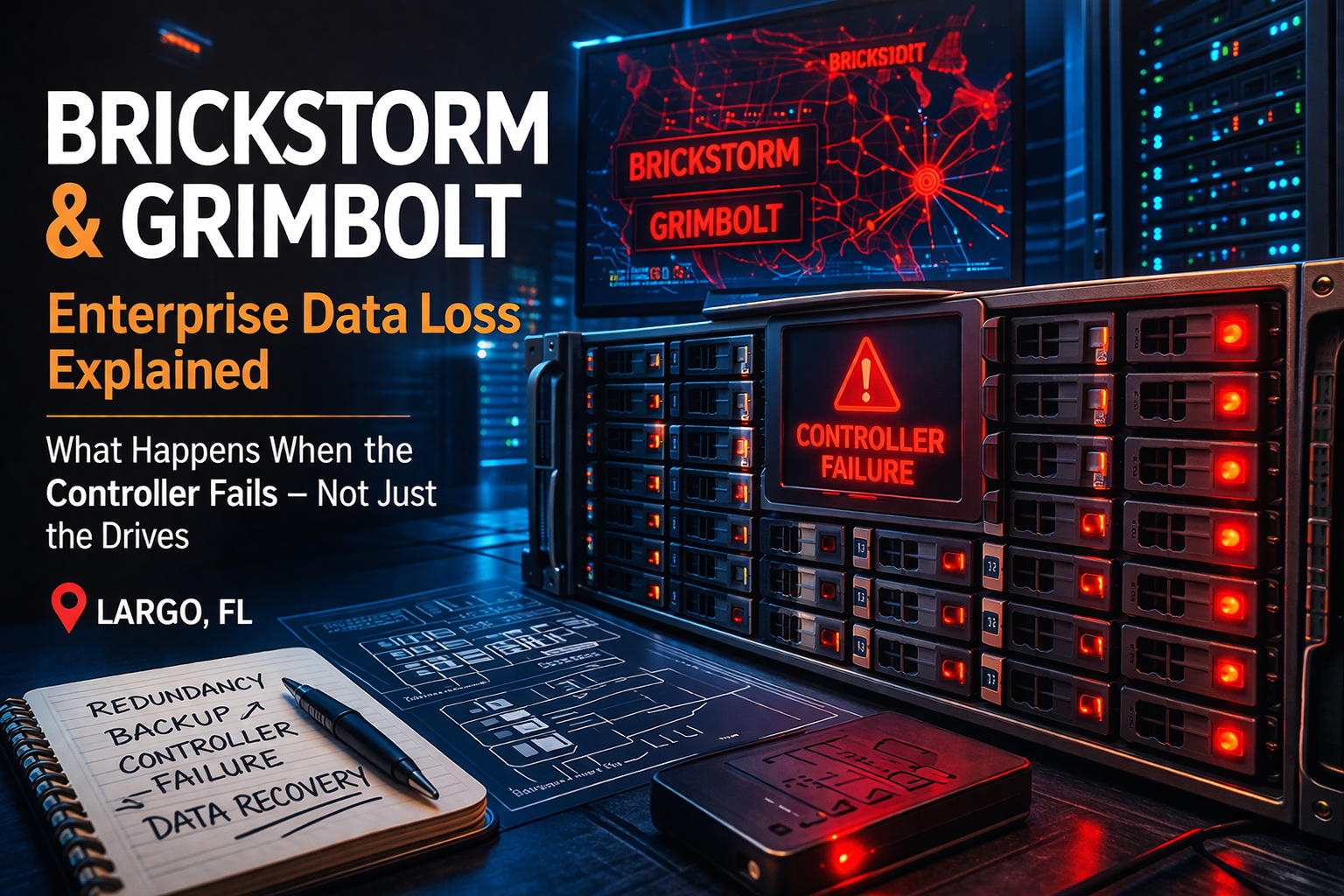
In February 2026, an unnamed federal agency was impacted by what is now being referred to as BRICKSTORM and GRIMBOLT.
This wasn’t a typical failure scenario.
The attack didn’t target individual drives. It targeted the controller managing the drives.
Under normal conditions:
- A single drive failure is handled automatically
- Even multiple drive failures can be tolerated depending on configuration
- Systems rebuild and continue operating without interruption
But this attack bypassed all of that.
By targeting the controller, the attackers effectively:
- Broke the redundancy model
- Disabled the protection mechanisms
- Disrupted the systems responsible for rebuilding and recovery
It didn’t just take down storage—it took down the logic that made storage resilient.
Why This Was Different
Targeting individual disks is predictable. Systems are designed for that.
Targeting the controller is not.
It’s similar in concept to attacking the coordination layer instead of the components themselves—once that layer is compromised, the protections don’t behave as expected.
Instead of isolated failures, everything becomes dependent on a system that is no longer functioning correctly.
Understanding Data Recovery as a Tiered System
Data recovery isn’t a single process—it’s a spectrum, and it depends heavily on the level of risk and investment.
Think of it like tiers:
Home Users (Basic Risk Level)
Most recovery situations involve:
- Accidentally deleted files
- Minor corruption
- Limited backup strategies
Recovery at this level is often constrained by:
- Cost tolerance
- Lack of redundancy
- User behavior
Business Environments (Planned Risk)
Businesses typically:
- Implement scheduled backups (daily or more frequently)
- Work within a defined recovery window
- Accept some level of data loss within that window
They rely on:
- Backup systems
- Managed infrastructure
- Recovery planning
Even here, threats like ransomware can disrupt both primary data and backups.
Enterprise / Agency Level (Complex Recovery)
In scenarios like BRICKSTORM and GRIMBOLT:
- The failure isn’t isolated
- The protection systems themselves are compromised
- Standard recovery methods don’t apply
At this level, recovery may require:
- Specialized extraction methods
- Reconstruction of fragmented data
- Deep understanding of how the system was originally structured
Only a limited number of specialists can even attempt recovery in these cases.
What Happens When Recovery Isn’t Straightforward
Not all data can be recovered cleanly.
Even when data is extracted:
- It may be incomplete
- It may require parsing and reconstruction
- It may not return to its original usable state
In large-scale failures like this, recovery becomes less about “getting files back” and more about salvaging what can still be interpreted and used.
When Data Recovery Still Applies at Smaller Scales
While enterprise-level attacks are rare, the underlying concept still applies:
Once the system managing your data begins to fail, recovery becomes more complex and less predictable.
In smaller environments, controlled handling—such as isolating the drive and working from a clone—can make data recovery in Largo, FL possible before the situation worsens.
Final Thought
Data loss isn’t always about a single drive failing.
Sometimes it’s about the systems designed to prevent failure no longer working as intended.
And when that happens, recovery becomes less about convenience—and more about what’s still possible.
Leave a Reply